
An overseas patient rarely arrives as a tidy row in a database. The first message may contain a diagnosis, three photographs and a voice note. A spouse asks about visas. Two hospitals return estimates in different currencies. A doctor needs clearer imaging. An insurer wants an approval reference. Meanwhile, the patient expects one confident answer: “What happens next?”
That is the operational problem medical tourism software is built to solve. It gives facilitators and hospital teams one place to manage the commercial, clinical-administrative and logistical work around an international patient. The software does not deliver medical care or replace clinical judgment. It makes the journey surrounding that care visible, coordinated and accountable.
In 2026, that distinction matters. A contact database may store a patient’s phone number. A medical tourism platform should help a team move the case from enquiry to treatment and follow-up without losing documents, context or ownership along the way.
What is medical tourism software?
Medical tourism software is a purpose-built system for coordinating people who travel outside their usual place of residence for treatment. It connects lead management, patient intake, provider selection, treatment estimates, approvals, travel support, communication, billing and post-treatment follow-up in a single operating workflow.
The phrase is sometimes used interchangeably with “medical tourism CRM.” There is an overlap, but the scope is different. A CRM concentrates on relationships, enquiries and conversion. Medical tourism management software usually extends beyond conversion to case coordination, treatment logistics, financial administration, and aftercare.
For a facilitator, the platform becomes the working record shared by sales advisers, medical coordinators, travel teams and finance. For a hospital, it supports the international patient department by collecting records, obtaining clinical opinions, preparing estimates, coordinating arrival, and following up after discharge. In both settings, the goal is the same: one reliable version of the journey.
Why email, chat and spreadsheets stop working
Small teams often begin with familiar tools. That is sensible while case volumes are low. The problem appears when information becomes distributed: the current estimate is in one inbox, the surgeon’s response is in a messaging thread, passport details are on a shared drive, and the payment status lives in a spreadsheet maintained by finance.
This fragmentation creates more than administrative inconvenience.
- A delayed response can weaken patient confidence when they are comparing providers.
- A coordinator may act on an outdated estimate or incomplete medical file.
- Managers cannot see which stage is slowing the journey or why enquiries are being lost.
- Sensitive records may be forwarded more widely than necessary.
- When a colleague is absent, the rest of the team has to reconstruct the case.
The risk grows with every handoff. International patient journeys routinely involve the patient, family, facilitator, doctor, hospital, insurer or sponsor, transport providers and internal finance teams. General-purpose tools can hold fragments of that work; they rarely provide the workflow and controls needed to connect it.
The journey a medical tourism platform should support
Good software mirrors the real patient journey rather than forcing every case into a sales funnel. Global Healthcare Accreditation describes the medical travel care continuum in three broad phases: pre-arrival communication and education, care and treatment, and post-treatment follow-up. Operationally, most teams need more detail.
Enquiry and qualification
The system should capture enquiries from relevant channels, preserve the original source and assign an owner. Structured intake helps the team record the requested treatment, destination preference, medical need, budget or funding route, travel readiness and language requirements. This is the first opportunity to set response deadlines and prevent a promising enquiry from going quiet.
Medical record collection and clinical review
Coordinators need a clear checklist for reports, imaging, prescriptions and identification documents. Files should sit within the patient case, with versions and access controls, rather than being scattered across personal inboxes. The platform should also show what has been requested, what is missing and which clinician or provider is reviewing the information.
Provider matching and treatment planning
A searchable network of hospitals and doctors helps teams match a case by speciality, location, capability and agreed commercial terms. The software should preserve the options considered, questions exchanged and clinical-administrative recommendations received. This makes the final proposal easier to explain and audit.
Estimates, funding and approvals
International treatment estimates can include professional fees, hospital charges, implants, diagnostics, expected length of stay and exclusions. A platform should standardize how these figures are requested and presented while retaining the source document. For insured or sponsored cases, it should also track pre-authorisation or guarantee of payment status, conditions, limits and expiry dates.
Travel and arrival coordination
Once the patient accepts a plan, the work expands beyond treatment. Visa letters, appointments, airport transfers, accommodation, interpreters and companion arrangements may all have dependencies. A shared timeline helps the team distinguish confirmed items from requests and alerts coordinators when a change affects another task.
Treatment, discharge and settlement
During treatment, authorised users need quick access to current case information and a record of important updates. At discharge, the platform can bring together the final invoice, payment status, discharge summary and follow-up plan. Multi-currency charges and partner commissions may also need to be reconciled against the agreed estimate.
Follow-up and continuity
The journey does not end at the airport. Patients may need wound reviews, medication checks, rehabilitation, repeat diagnostics or a remote consultation with the treating doctor. Scheduled follow-up protects continuity of care and gives the organisation a more accurate view of experience and outcomes.
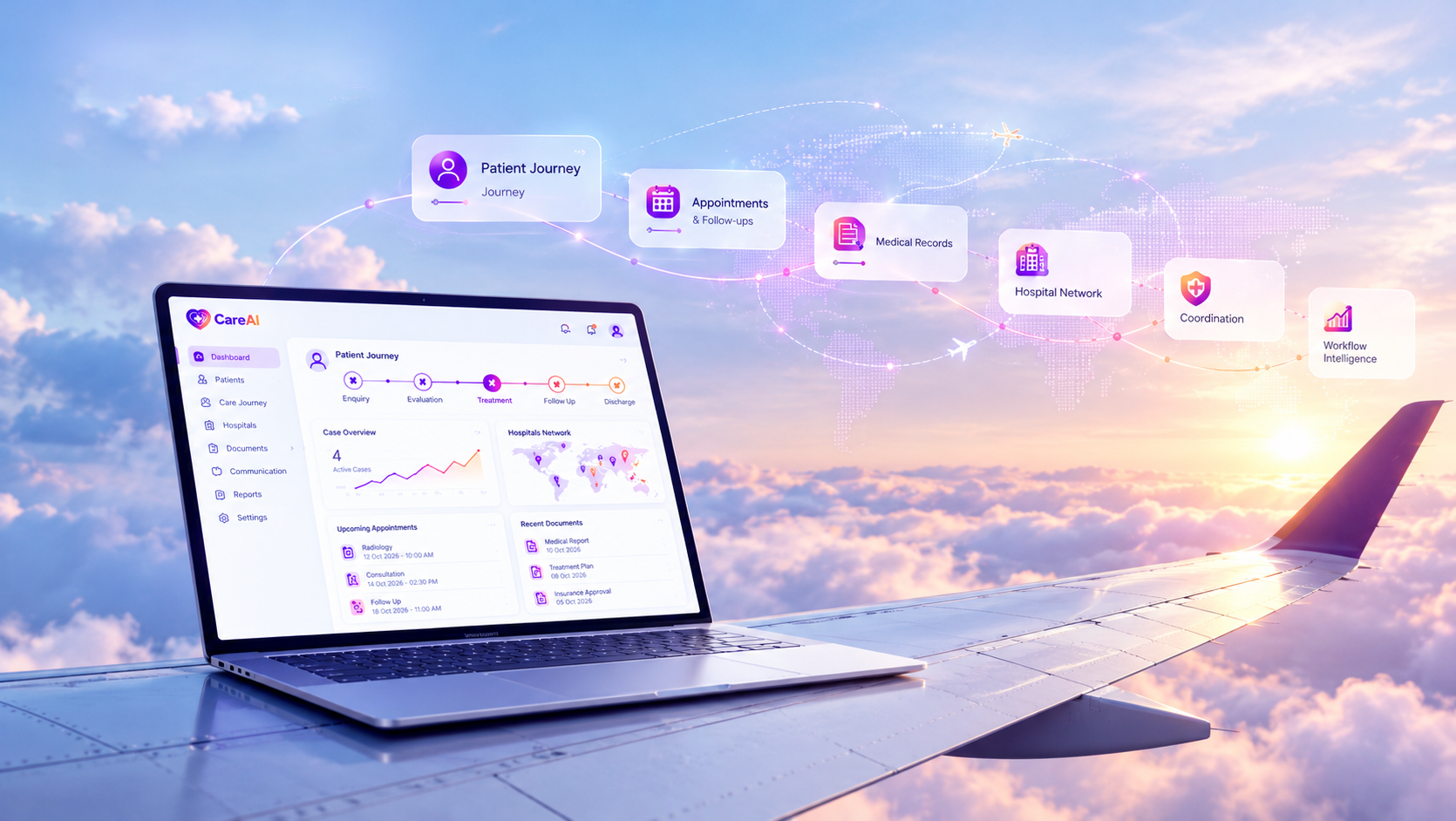
Ten capabilities worth looking for
Feature lists can become overwhelming, so evaluate them against the work your team performs every day.
- Lead and referral managementCapture source, campaign, referrer and owner, with a configurable pipeline and reminders.
- A connected patient caseKeep demographics, communications, tasks, providers, documents, estimates and payments linked to the same record.
- Secure document workflowsSupport controlled access, clear document categories, missing-item checklists and version awareness.
- Provider and partner network managementRecord specialities, locations, contacts, service history, tariffs and referral arrangements.
- Treatment estimate workflowsRequest, compare, approve and revise quotes without losing the decision history.
- Communication in contextKeep relevant email, messages, notes and call outcomes visible to authorised colleagues.
- Journey and task automationTrigger checklists, deadlines and escalations according to treatment or case stage.
- Financial coordinationTrack deposits, invoices, insurer or sponsor approvals, partner fees and settlement status.
- Management reportingMeasure response time, conversion, case cycle time, revenue, referral performance and unresolved bottlenecks.
- Security and governance controlsProvide role-based permissions, audit history, data retention options and appropriate safeguards for patient information.
Artificial intelligence can assist within several of these capabilities for example, by extracting information from uploaded reports, summarising a long case history or warning that an approval is approaching expiry. It should support the coordinator, not make unsupervised clinical decisions. Human review, source traceability and clear accountability remain essential.
Medical tourism software for facilitators versus hospitals
Facilitators and hospitals share much of the same journey, but their operational emphasis differs.
Facilitators
A facilitator usually needs strong enquiry conversion, comparison of multiple providers, referral tracking, travel coordination and partner settlement. It may manage cases across countries, currencies and healthcare networks. The platform must make it easy to present options without losing the provenance of each estimate.
Hospitals
A hospital international patient department is more focused on moving information through internal teams. It needs dependable handoffs between the international office, consultants, diagnostics, admissions, finance and discharge planning. Integration with existing hospital or clinical systems may be important, because the medical tourism platform should complement the hospital’s source systems rather than create a competing clinical record.
Organisations that serve both models should test whether the software can adapt workflows and permissions by business unit, facility, country or partner.
How to choose the right platform
Start with five to ten recent cases and map what really happened. Note every person involved, document requested, approval obtained, handoff completed, and delay encountered. Then ask vendors to demonstrate those journeys using realistic scenarios not a generic slideshow.
During evaluation, explore these questions:
- Can the workflow reflect different treatments, funding routes and destinations?
- How quickly can a coordinator understand the full status of an unfamiliar case?
- What prevents duplicate records, missed tasks and use of an outdated document?
- Can patients, providers and referral partners share information without receiving unnecessary access?
- Which integrations are available, and who owns the work of maintaining them?
- How are permissions, audit logs, backups, data location and incident management handled?
- Can managers build useful reports without exporting everything to spreadsheets?
- What implementation, training and support are included after purchase?
Security requirements should be assessed against the laws and contractual duties that apply to your organisation and patient population. For example, the US HIPAA Security Rule requires regulated entities to protect electronic protected health information through administrative, physical and technical safeguards. European data-protection rules may also affect organisations handling the data of people in the EU, including some international transfers. A software claim or certification badge is not a substitute for legal, security and operational due diligence.
A practical route to implementation
Technology cannot repair an unclear process by itself. Before configuration, agree who owns each stage, what information is mandatory and what qualifies a case to move forward. Remove duplicate fields and approvals that exist only because information was previously hard to find.
Roll out a limited set of high-value workflows first: enquiry intake, medical document collection, treatment estimate coordination and follow-up tasks. Train with real scenarios. Give coordinators a simple route to report friction, then refine templates and automations after observing how the system is used.
Data quality also deserves an owner. Define naming rules, source categories, required fields and how duplicate contacts will be handled. If teams continue to maintain parallel spreadsheets “just in case,” investigate the reason rather than banning the spreadsheet. It usually reveals a missing field, report or trust issue that needs attention.
The business case is clarity, not merely speed.
The most valuable result of medical tourism software is not that every human action disappears. It is that the right person can see the right next action, the patient receives a coherent experience, and management can improve the operation using evidence.
CareAI ONE is designed around this connected cross-border journey, bringing together enquiry and referral management, case coordination, treatment estimates and approvals, partner networks, travel support, settlement, reporting and post-treatment care. Organisations evaluating a platform can use the journey and capability checklist above to structure a focused demonstration around their own cases.
Visit CareAIFrequently asked questions
Is medical tourism software the same as a CRM?
Not exactly. CRM functionality manages enquiries, contacts, referrals and conversion. A medical tourism platform normally extends into medical-document coordination, provider selection, estimates, travel, treatment milestones, payment administration and follow-up.
Can a small facilitator benefit from medical tourism software?
Yes, if case information is already spread across several tools or follow-up depends on individual memory. The best starting point is a focused workflow with clear ownership, not an unnecessarily complex enterprise rollout.
Does the software replace an EMR or hospital information system?
Usually not. An EMR or HIS remains the authoritative clinical and hospital-operational system. Medical tourism software coordinates the cross-border patient journey and should exchange relevant information with source systems where appropriate.
What should a medical tourism platform automate first?
Prioritise repetitive, time-sensitive work such as enquiry assignment, missing-document reminders, estimate follow-up, approval expiry alerts and scheduled post-treatment contact. Keep clinical decisions and sensitive exceptions under human review.
How long does implementation take?
It depends on workflow complexity, data migration, integrations, security review and the number of teams involved. A staged implementation with agreed success measures is usually more reliable than attempting to configure every possible scenario before launch.